The Path to Xbox One X (“Project Scorpio”): A Development Roadmap Through Console Launch
Updated: July 6, 2017
In this topic
Release vehicles (XDK and Recovery)
Paths to release an Xbox One X-capable title
Titles enabled for Xbox One X hardware features
Xbox One X updates to existing and planned 2017 titles
Xbox One X development environment
Introduction
Xbox One X, the newest member of the Xbox One family of devices, will be available to consumers for Holiday 2017. This white paper presents answers to many common questions about development paths that you can pursue now and about compatibility across the Xbox One family. It also offers general guidelines for preparing titles to be successful regardless of the game console that a consumer plays on.
Release vehicles (XDK and Recovery)
Across the Xbox One family of devices, title developers generally are aware of two major points of interaction:
-
The Xbox Development Kit (XDK) libraries, against which a title is compiled.
-
The Xbox One Recovery Update—the underlying system services, shell experiences, title-callable UI, and other features.
- Note that, during Xbox One X bring-up, development recoveries diverge from consumer-facing recovery releases; they reconverge with the October 2017 Recovery.
Because titles (and particularly titles that enable Xbox One X features) are dependent on capabilities of both, these two resources are broken out separately in the following timelines.
Xbox One X timeline
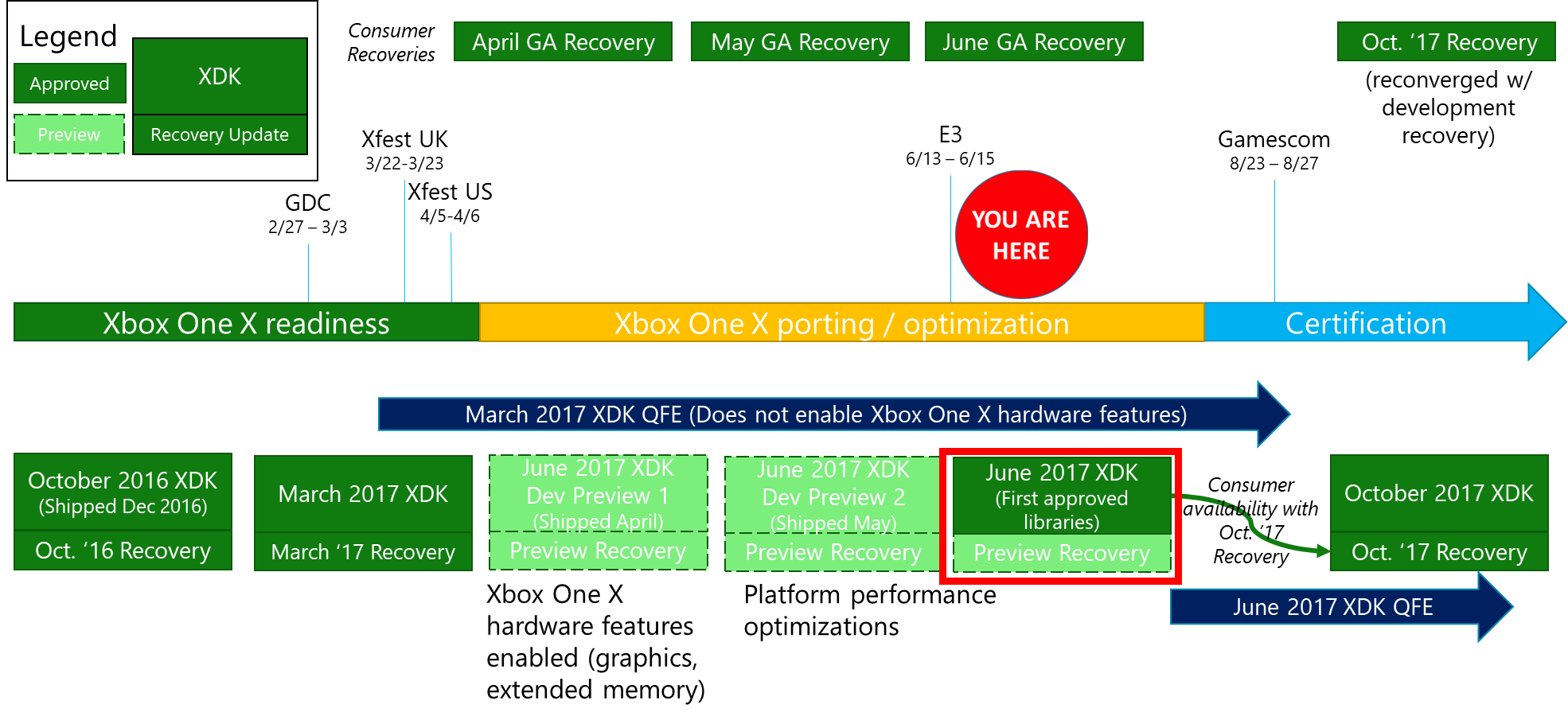
| Release name | Preview or approved? | Major feature beats |
|---|---|---|
| October 2016 (1610) XDK | Approved | What’s new |
| October 2016 (1610) Recovery | Approved | Xbox Holiday 2016 Update |
| March 2017 (1703) XDK | Approved | What’s new |
| March 2017 (1703) Recovery | Approved | Spatial audio—general availability for consumers |
| June 2017 Developer Preview 1 (1706) XDK (Available in April) | Preview | What’s New Enable Xbox One X graphics stack Xbox One X dev kit interaction APIs (screen, buttons, etc.) XDK Transfer Device (high speed deployment and data transfer) support Enable Xbox One X extended memory access |
| June 2017 (1706) Developer Preview 1 Recovery (Available in April) | Preview | N/A |
| June 2017 Developer Preview 2 (1706) XDK (Available in May) | Preview | Goal: No breaking API changes Performance optimizations: ~80%-90% of launch performance targets |
| June 2017 Developer Preview 2 (1706) Recovery (Available in May) | Preview | N/A |
| June 2017 (1706) XDK | Approved (for certification; for street date, requires next approved recovery [1710]) | Xbox One X launch libraries Xbox One X graphics stack reaches launch target Certification opens for launch titles |
| June 2017 (1706) Recovery | Preview | N/A |
| October 2017 (1710) XDK | Approved | N/A |
| October 2017 (1710) Recovery | Approved | Xbox One X launch recovery (used by all consoles in the Xbox One family) – titles (1706, 1710 XDKs) can ship to consumers when this recovery reaches retail |
Paths to release an Xbox One X-capable title
Titles can take several paths to become Xbox One X enabled.
| Scenario | XDK plan | Testing and QA | Cert |
|---|---|---|---|
| I’m releasing before Xbox One X launch. The game will NOT have Xbox One X enhancements. |
Use any approved XDK before June 2017 (1706). | Test as usual and validate on Xbox One devkits. | Submit any time. |
| I’m releasing before Xbox One X launch. The game WILL have Xbox One X enhancements. | Use March 2017 (1703) XDK for game launch. Release a CU built against June 2017 (1706) XDK after the October 2017 (1710) recovery has been released to retail. Use the June 2017 (1706) Developer Preview releases; building and testing your game early and continuously against the 1706 preview releases will aid in a smooth CU development. |
Test both 1703 and branched versions on all console configurations. | Submit 1703 version any time. Submit 1706 version for optional final as soon as cert allows (June). Work with your account team to schedule final cert and release of 1706 CU. |
| I’m releasing after Xbox One X launch. The game WILL have Xbox One X enhancements. | Move to June 2017 (1706) Developer Preview releases now. | Test on all console configurations. | Standard submission planning. |
Forward compatibility
With no extra title-development effort, all titles built against existing approved XDKs are guaranteed by policy to function on Xbox One X hardware. (This is one of the reasons that symbols are requested along with title submissions.) As a best practice, make use of dynamic resolution scaling, and author your titles to be change resilient. This approach won’t make explicit use of new hardware capabilities found on Xbox One X, but it will implicitly take advantage of some performance gains on the new console. For more info, see these resources:
Titles enabled for Xbox One X hardware features
To create a title to ship at Xbox One X launch, you can adopt the June Developer Preview (1706) XDKs in advance of the first approved libraries with the June 2017 (1706) XDK. Note that, while it’s usable for development across the Xbox One family of consoles, the underlying June (1706) recovery will not be approved, nor will it be available on retail Xbox One family consoles, until Xbox One X launch as the October 2017 (1710) recovery. Therefore, discs and digital downloads cannot be distributed to the public until that recovery is approved and released.
Xbox One X updates to existing and planned 2017 titles
You may want to ship titles before Xbox One X availability, and then enable Xbox One X hardware features when the console ships to the public. You can develop and ship such titles against any existing approved libraries. As with the forward-compatibility scenario discussed previously, making use of dynamic resolution scaling and authoring code to be change-resilient are best practices. Continue to service this release (refreshing content and delivering other updates) until the October 2017 recovery achieves general availability.
For Xbox One X work, continue development via the June 2017 (1706) Developer Preview XDKs. Certify against the June 2017 (1706) XDK. Then ship this single codebase (as discs, digital downloads, and/or content updates) when the October 2017 recovery ships.
To reduce the size of Xbox One X launch-day content updates, we recommend that you evaluate using the March 2017 (1703) Xbox One Tools SDK with existing titles. That SDK introduces intelligent delivery capabilities, which allow individual chunks of the title package to be marked for specific console capabilities (or language/locale support, or several additional pivots). These capabilities can be used with earlier approved XDKs, so you can deliver packaging updates without having to recompile or update content in shipped assets. The March 2017 (1703) XDK also adds related APIs for titles to dynamically and programmatically manage streaming installation.
Xbox One X development environment
The Xbox One X development environment will remain shared with other Xbox One title development. For title developers, notable areas of evolution from the experience in the October 2016 XDK include:
- Microsoft Visual Studio 2015 or later as base development requirement (Update 3 recommended). As previously announced, Visual Studio 2012 support was discontinued for XDKs released after December 31, 2016. (XDKs released after Visual Studio 2017 was released support Visual Studio 2015 and Visual Studio 2017.)
Visual Studio 2015 benefits include:
-
Significantly faster compiler/linker times, measured in many cases as improved by 20% or more over Visual Studio 2012
-
Edit and Continue support (new for the October 2016 XDK)
-
Xfest 2016 talk: “Xbox One Development Tools” (Video | PowerPoint)
-
Xfest 2015 talk: “Visual C++ 2015 for Xbox One” (Video | PowerPoint)
-
An Xbox One X-specific development kit, featuring capabilities that add utility and speed to title development, iteration, and validation. Although capabilities are dependent on the hardware, the corresponding APIs will be available across the Xbox One family. Many of these APIs surface in the March 2017 (1703) XDK, though they return only existing Xbox One capabilities until the June 2017 (1706) Developer Preview 1 XDK.
Other enhancements included in the March 2017 (1703) XDK and recovery benefit all development consoles in the Xbox One family:
-
Unattended and hands-free console registration and activation
-
Optional console auto-recovery (already available beginning in the August 2016 (1608) recovery via the Dev Home app), adding support for studio-default console settings and settings groups
-
Studio IP address whitelisting, which, when paired with an activated console, means development kits can renew certificates automatically (or manually within Dev Home)
-
Console access (via the Windows Device Portal service) from a web browser on any local subnet device (already available beginning in the August 2016 (1608) recovery Dev Home)
Summary
This white paper calls out actions developers can take today to ensure their titles will be prepared to successfully and performantly run on all devices across the Xbox One family of consoles. To review the main actions you can take today:
-
Ensure your title is already taking advantage of dynamic resolution and change resilient (that is, CPU scalable) coding practices.
-
Update to Visual Studio 2015 (Update 3 recommended) if you haven’t already.
-
Evaluate intelligent deployment capabilities made available in the March 2017 Tools SDK (which allows repackaging of titles from earlier XDKs without a recompile or updated operating system image), even if your title does not adopt the full March 2017 XDK.
-
Ship against the June 2017 (1706) XDK (or later) to explicitly take advantage of Xbox One X hardware capabilities.