Updated: March 5, 2014
The Sound of the Future: Xbox One Audio Architecture
The audio architecture in Xbox One seeks a balance between the successes and tradeoffs of previous-generation platforms while anticipating the increasing technical needs of next-generation implementations. It provides hardware-accelerated pathways for the most common aspects of audio rendering-compression, mixing, filtering, and so on-on a large number of concurrent voices. The architecture also provides a shared resource model for software processing consumption, allowing individual titles to select what and how much custom signal manipulation to apply in CPU utilization. This topic describes these software and hardware characteristics of the audio architecture on Xbox One and how they might influence implementation choices.
Audio architectural overview
In addition to general CPU power, which can be used for decoding, synthesis, rendering, and so on, Xbox One provides several hardware components dedicated to audio processing. The audio hardware components can address the entire unified memory space.
Figure 1. An illustration of the hardware-accelerated audio components
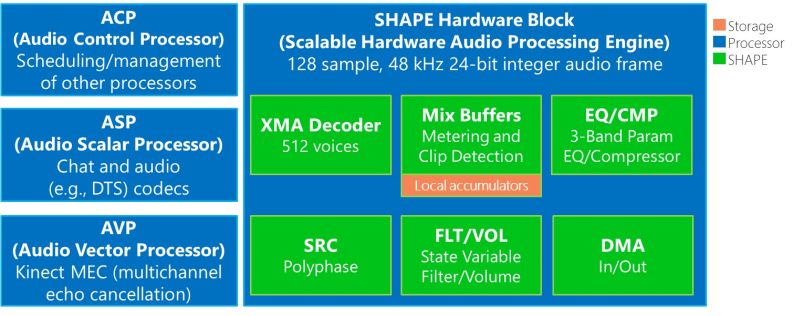
The SHAPE (Scalable Hardware Audio Processing Engine) block makes up the majority of the audio functionality on Xbox One, although the other processors also contribute significant features. The ACP (Audio Control Processor) provides state management and scheduling. The ASP (Audio Scalar Processor) supports scalar float and vector integer operations. Finally, the AVP (Audio Vector Processor) supports vector float operations and is designed primarily for multichannel echo cancellation (MEC).
SHAPE
The core hardware dedicated to audio processing is SHAPE. It is designed to perform many of the basic operations commonly required on a per-voice basis. This hardware allows a developer to reduce CPU impact—even for high polyphony and complex signal routings—and still provide the flexibility of SHAPE/CPU data interchange if a title chooses to perform custom digital signal processing, analysis, or software synthesis.
SHAPE operates on blocks of 128 samples, with each sample supporting 24-bit integer resolution or 32-bit float when used by the CPU. At 48 kHz, this represents a 2.67 ms audio frame, providing increased timing resolution and decreased latency compared with the 256-sample block size on Xbox 360. SHAPE offers six fixed-function blocks focused on common audio tasks:
XMA decoder
Concurrent decodes of 512 XMA format voices. XMA is a perceptual codec developed for Xbox 360, offering user-tunable quality and typically providing between 6:1 and 14:1 compression.
SRC
A high-quality dedicated polyphase sample-rate conversion block allowing for high performance and high-quality frequency resampling of 512 mono channels of audio data (whether for format conversion, Doppler effect, or pitch variation).
Mix buffers
Dedicated accumulators for 128 in-place mix channels without needing to access memory, and with a total of 8,192 channels available virtually. These mix buffers also provide coarse metering and clipping detection for debugging and monitoring.
FLT/VOL
A module providing both volume scaling and a state-variable filter implementation for 2,560 voices/mixes, analogous to the software-exposed XAudio2 per-voice filter available on Windows and Xbox 360. The filter can provide low pass, high pass, band pass, or notch filtering, and it exposes Q and cutoff/center frequency parameters. It is used most commonly for distance and occlusion modeling.
EQ/CMP
A module providing up to 512 channels of three-band equalization and dynamic range compression. The EQ consists of three serially cascaded bi-quad filters. The compressor has a hard-knee response, and it supports both side chain and expander functionality.
DMA
SHAPE has dedicated DMA hardware for transferring audio data to and from the unified memory space. This enables scenarios that include transfer without a sample-rate converter, transferring final mix channels, and CPU-based processing in the middle of a SHAPE-based audio graph.
Playback of a typical audio graph is expected to use each of these processors extensively.
ACP
The ACP provides state management and scheduling of all other audio hardware components on the North Bridge. CPU involvement in intraframe processing and the synchronization or latency it might introduce is unnecessary.
ASP
The ASP supports scalar float and vector integer operations. Voice chat codecs—both those that manage wireless communication between a voice chat headset and the console, and those that are used to compress/decompress Silk codec voice data for networked voice communication—are provided in the hardware.
AVP
The AVP supports vector float operations. It is designed primarily for multichannel echo cancellation (MEC) and other noise reduction for the next-generation Kinect audio input. It supports both speech recognition and chat/arbitrary audio input use. MEC and other noise-reduction processing provide a more intelligible stream of the player’s spoken audio data even from a far talk microphone that is typically positioned closer to the output speakers than to the player.
Audio and Xbox One hardware
The audio output pipeline on Xbox One eliminates the DAC (digital-to-analog converter) found in previous-generation consoles. All audio is output strictly in the digital realm either through HDMI 1.4a or as S/PDIF optical output. HDMI 1.4a allows for high-fidelity linear 7.1-channel PCM to be transmitted from the console; titles default to an output sampling rate of 48 kHz and a bit depth of 24 bits. Xbox One is also designed to support up to four simultaneous stereo headset outputs, each of which can represent unique multichannel mixes that are downmixed as required by the output format (for instance, a headset or the S/PDIF output).
Xbox One accepts audio input from a variety of sources: the Kinect microphone array, voice chat headsets, or cloud-based resources. Audio also can be algorithmically generated through CPU-based computation and manipulated in real time on a CPU, through the aforementioned SHAPE hardware components, or both.
Compression formats
Xbox One offers hardware decompression support for XMA2, which provides significant storage, bandwidth, and memory reductions over uncompressed PCM. XAudio2 also offers software decode support for both xWMA and ADPCM (Adaptive Differential Pulse Code Modulation). Although the computation for the ADPCM format is low overhead, as a non-perceptual codec ADPCM can express noticeable artifacts at lower sampling rates.
| Format | Compression (approximate) | Xbox One | Xbox 360 | Loop capability |
|---|---|---|---|---|
| PCM | None | :white_check_mark: | :white_check_mark: | Arbitrary |
| ADPCM | 3.5–4:1 | :white_check_mark: (Software) | Block aligned | |
| XMA2 | 6–14:1 | :white_check_mark: (512 Hardware) | :white_check_mark: (320 Hardware) | 128 sample aligned |
| xWMA | 20–40:1 | :white_check_mark: (Software) | :white_check_mark: (Software) | End to end only, may gap |
Additional audio formats—for instance, MP3 or OGG—for game assets can be provided through title or middleware software codecs running on a CPU.
Audio and the Xbox One app model
While it is in the foreground, an application has full access to the SHAPE hardware. When that application is pushed to the background—pinned, picture-in-picture, or other scenarios—it relinquishes hardware control. By default, its hardware state is suspended, and it resumes when the title returns to the foreground. This also is true for Exclusive Resource Applications (ERAs) where the software graph is suspended.
A title can optionally choose to tear down its audio graph and reconstruct it upon resume. Some titles, particularly Shared Resource Applications (SRAs) that play background music such as streaming radio, might choose to have some aspects of audio continue to play even while paused. For these scenarios, titles should closely evaluate whether to attempt a seamless transition from hardware to software rendering, or to always play audio intended for background playback via a software-only pipeline. This has implications for compression formats and CPU costs. XMA-compressed assets, for example, require the use of SHAPE hardware, and thus will not be decodable for a background application.
The XAudio2 audio engine does provide software pathways for many functions if a title chooses to allocate CPU resources. Where practical, these functions mimic hardware capabilities, but some compute-intensive processing is either unavailable or is differently implemented in software. Titles transitioning from hardware processing to software processing based on an app’s state might want to consider these differences when planning their audio pipelines.
| Feature | Xbox One hardware capability | Xbox One software capability | Equivalent? |
|---|---|---|---|
| Sample-rate conversion | (SRC) Polyphase | XAudio2 linear interpolation | No |
| Parametric EQ | (EQ/CMP) Three-band EQ | Simple one-band EQ or custom DSP | No |
| Compressor/limiter | (EQ/CMP) Hard-knee, side chain, and expander capabilities | Custom DSP | No |
| Filtering | (FLT/VOL) State-variable filter | XAudio2 state-variable filter, single-pole LPF, or custom DSP | Yes |
| Mixing | (Mix buffers) Includes clip detection, metering | Software mixing; custom DSP for clip detection or metering | Yes (for mixing) |
Xbox One audio libraries
Xbox One supports two audio-rendering APIs for typical game use along with a variant of the Windows 8 Media Foundation API for playback of user music:
- XAudio2, a game-focused audio library already available on Xbox 360 and Windows operating systems (Windows XP to Windows 8), is generally recommended for most title development.
- WASAPI (Windows Audio Session API) can be used for any custom, exclusively software-implemented pipeline. WASAPI provides audio endpoint functionality only. Decompression, sample-rate conversion, mixing, and digital-signal processing, as well as interactions with the audio hardware components on Xbox One, must be implemented by the client. WASAPI is most typically used by audio middleware solutions.
The Microsoft Cross-Platform Audio Creation Tool (XACT) and DirectSound are not supported in the Xbox One environment. Titles that previously used these technologies should consider the solutions identified above or use approved Xbox One audio middleware options.
Wrap-up: getting started today
Title content creators and implementers that are beginning Xbox One development should consider the following at the start of their planning:
- Plan for 7.1 audio. This encompasses both pre-rendered content and real-time content panning and positioning. Consider how your title will use each audio channel.
- Explore and understand audio compression options. Understand the acoustic and size differences for XMA, xWMA, and ADPCM compression. Evaluate quality/bitrate settings for your content to understand expected budget targets on Xbox One.
- Consider usage patterns for hardware-accelerated DSP processing, particularly if your title intends to implement occlusion/obstruction simulation.