Xbox One System Hardware Overview
Updated October 31, 2014
Xbox One is the successor to the Microsoft Xbox 360 console. This topic provides a high-level overview of the hardware features from a developer’s perspective.
Xbox One consoles provide powerful hardware that developers can effectively leverage with familiar tools such as Visual C++ and PIX. Though the hardware architecture is significantly different from Xbox 360, developing applications for Xbox One is just as straightforward.
In this topic:
- Basic hardware specifications
- CPU
- CPU caches
- GPU
- Memory and bandwidth
- Move engines
- Video codec
- Storage
- Input/Output
- Audio
- Kinect
- Controller
- Xbox One Development Kits
- Summary
Basic hardware specifications
The Xbox One console is powered by custom hardware design that includes an 8-core 64-bit CPU running at 1.6 GHz, an 853MHz DirectX 11.x graphics processor, and a number of custom hardware blocks. See the following Retail System Block Diagram for details on the overall system architecture. Both retail consoles and development kit hardware have 8 GB of unified memory. There is no requirement for graphics resources to be located in dedicated video RAM.
The same operation system runs on both the retail console and the development kit console. The Xbox One operating system represents the evolution to the next generation of the Xbox 360 operating system. The graphics interfaces are a specific superset of the Microsoft Direct3D 11.1 API released in Windows 8.
CPU
The Xbox One console includes a CPU with a total of eight processor cores, where each core has one fully independent hardware thread with no shared execution resources. Each core is an advanced x64 processor running at 1.75 GHz. The eight independent processor cores are organized into two modules of four cores each.
Xbox One’s CPU architecture includes state of the art features such as out-of-order processing with speculative execution, store forwarding, register renaming, and advanced branch prediction hardware. These features allow the CPU to hide a significant number of potential pipeline stalls and achieve much higher effective execution rates than the Xbox 360 CPU in most cases.
Each hardware thread can issue two instructions per clock. At peak performance, the Xbox One CPUs can issue and retire 28.0 billion instructions per second. The Xbox 360 CPU also has a relatively high theoretical peak instruction rate, however in practice most titles are able to achieve an effective execution rate of 0.15 to 0.2 instructions per clock (IPC) on average, well below the peak throughput. As a result of out-of-order execution and many other architectural improvements, the Xbox One CPU is expected to consistently achieve an IPC value in the range of 0.6 to 1.0, delivering throughput much closer to peak values.
Figure 1. Retail System Block Diagram
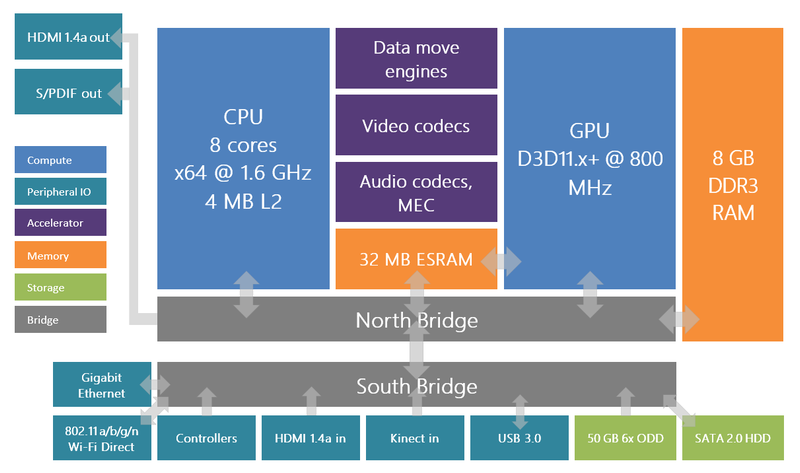
As a state of the art x64 processor, the CPU includes support for the standard x64 instruction-set architecture including streaming SIMD extension (SSE) varieties up to and including SSE 4.2 as well as support for cryptographic instructions. The CPU also supports the AVX instruction set including 256-bit wide SSE registers (YMM0-15) and three operand instructions providing non-destructive register syntax. The CPU decodes AVX instructions into two 128-bit wide SIMD micro-operations during instruction decode.
CPU caches
Each CPU thread has its own 32 KB L1 instruction cache and 32 KB L1 data cache. Each module of four CPU cores has a 2 MB L2 cache resulting in a total of 4 MB of L2 cache. The L2 cache is the first sharing point between CPU cores.
The CPU supports explicit cache pre-fetch instructions. However both the L1 and L2 caches include special hardware for intelligent pre-fetching of data. The hardware pre-fetch units monitor data access patterns and predict future data requests. The pre-fetch units predict both sequential and strided data access with positive or negative offsets. As a result, data will often be resident in the cache before the CPU explicitly requests it. The L2 cache system provides a slightly lower penalty for a remote L2 cache hit relative to a main memory fetch.
GPU
The GPU hardware architecture for the Xbox One console is a custom D3D11.1 class 853-MHz graphics processor. The GPU has 12 shader cores providing a total of 768 threads. Within the shader cores, resources are automatically and dynamically assigned to processing tasks, rendering or computing based on load and dependencies. Each thread can perform one scalar multiplication and addition operation (MADD) per clock cycle. At peak performance, the GPU can effectively issue 1.31 trillion floating-point operations per second.
The GPU has a peak pixel fill rate of 13.65 giga-pixels/sec. The peak vertex rate is 1.7 billion vertices/sec, and the peak triangle rate is 1.7 billion triangles/sec. The GPU can fetch 40.94 giga-texels/sec.
The Xbox One graphics architecture has a unique design implementing a superset of Direct3D version 11.1. The GPU operates on virtual addresses for resources using its own 64-bit memory management unit (MMU). The graphics architecture incorporates a number of important features and extensions:
- GPU-specific L1 and L2 caches
- Hardware virtualized texture memory
- Compression for color and depth buffers with or without MSAA
- Atomic operations
- Reads and writes coherent with the CPU caches
- The ability to explicitly flush its own cache lines
- Three fully independent display planes
Titles have access to two of the display planes. The system reserves the third display plane for system UI and notifications. Each display plane can have arbitrary position, resolution, format, refresh rate, and size relative to the screen. The display planes can be independently scaled in hardware to the final display output resolution. Display planes are composited using source alpha and alpha values can also be pre-multiplied.
Memory and bandwidth
Both the Xbox One retail console and development kits have 8 GB of DDR3 system memory. The peak system memory read/write bandwidth is 68 GB/sec. The memory architecture is unified which means that system memory is equally accessible to both the CPU and the GPU.
Xbox One consoles have 32 MB of fast embedded SRAM (ESRAM) with a peak bandwidth of 109 GB/sec. The GPU can directly access resources that reside in either system memory or ESRAM. Embedded RAM can therefore be used as flexible high speed scratch memory that can be both read from and written to by the GPU. From the GPU’s perspective the bandwidths of system memory and ESRAM are parallel providing combined peak bandwidth of 177 GB/sec.
Because the GPU operates on virtual addresses there are no functional differences between ESRAM and system memory. Titles are free to choose where various GPU-accessible resources reside including the frame and depth or stencil buffers. The only exception is the front buffer which must reside in system memory. A unique benefit of this architecture is that it is possible through page table mappings for a frame buffer to be constructed that includes page-sized mixtures of both ESRAM and system memory.
Move engines
The Xbox One GPU contains dedicated hardware units called Move Engines for block memory transfer operations. There are a total of four move engines. The move engines perform copy operations to and from any combination of system memory or ESRAM. Each of the move engines can optionally apply texture swizzle or un-swizzle transformations to data as it is transferred. One of the move engines can perform an LZ77 encode, while another can perform either an LZ77 or JPEG decode.
Video codec
Xbox One includes dedicated hardware that can perform video encode and decode operations. The video codec hardware supports 1080p encode and decode at 30 Hz. Titles can decode VC1, MPEG2, and H.264 using High profile. Titles can encode H.264 video using Baseline profile level 4.2.
Storage
Xbox One cconsoles include significantly increased storage capacity in comparison to Xbox 360. All Xbox One retail consoles include a hard disk drive (HDD) and an optical disc drive (ODD). Xbox One also includes embedded flash memory, which is reserved for system use to accelerate certain system operations.
Titles have access to data stored on the hard disk drive and to data stored remotely in the cloud by way of Xbox LIVE services. The hard disk can deliver sustained read speeds of up to 50 MB/sec. The hard disk is 500 GB in size. The system reserves a portion of the HDD for its own use.
The Xbox One optical disc drive is a high-capacity drive providing up to 50 GB of physical storage. The ODD provides an average of 18 MB/sec throughput with an anticipated 200 ms seek time including layer switch. Titles cannot directly access data on the ODD. Instead the ODD is used by the system for installation of full titles to the hard disk drive. Titles provide a file manifest defining the minimal files required to begin execution in priority order. This system enables the title to begin executing while file installation continues in the background.
Input/Output
Xbox One consoles are designed for high bandwidth connectivity. The console has built-in Wi-Fi networking as well as a wired Gigabit Ethernet port. Attached devices, including Kinect, connect to USB 3.0 ports. Controllers connected to Xbox One are wireless only – there are no dedicated controller ports. Video output is provided by High Definition Multimedia Interface (HDMI) 1.4a which enables full 1080p stereo display output. Audio output support is provided by either HDMI or Sony/Phillips Digital Interconnect Format (S/PDIF).
Audio
Audio in Xbox One consoles is provided by several dedicated hardware components. These components include an audio signal processing block, an audio codec processor, a Multi-channel Echo Cancellation (MEC) processor, and a scheduling processor. The console is able to output discrete 7.1-channel linear pulse-code modulation (PCM) data.
The Scalable Hardware Audio Processing Engine (SHAPE) block provides hardware XMA decoding for up to 512 voices, hardware mixing buffers, parametric equalization, filtering, and compressor/limiter dynamic range control. Typical XMA2 compression ratios range from 6:1 to 14:1. The SHAPE block can store and process 512 audio frame instances of 128 samples at 48 KHz (2.67 ms), and can use dedicated direct memory access (DMA) hardware to access data in system memory, allowing for intra-frame CPU-based and hardware-accelerated processing to be combined as the title demands.
The Audio Scalar Processor (ASP) is a codec block providing voice chat and audio codecs such as xWMA. Typical xWMA compression ratios range from 20:1 to 40:1.
The Audio Vector Processor (AVP) performs multichannel echo cancellation (MEC) on the incoming Kinect audio stream for speech recognition and chat.
Kinect
The Kinect sensor for Xbox One represents a significant advancement in natural user input (NUI) technology. Unique new and improved features of the Xbox One Kinect sensor include: a wider field of view, a lighting independent active IR stream, an improved depth sensor with increased resolution, accuracy and precision, and an HD RGB sensor. Xbox One provides a dedicated USB 3.0 bus for Kinect.
The wider field of view means that a tilt motor is no longer required for Kinect to work effectively in various environments. A person who is six feet tall can stand two feet closer to the sensor with the same tracking fidelity.
The active IR stream provides a lighting independent IR image at 30 Hz. The IR stream provides a grayscale image that is independent of ambient lighting, enabling more robust image processing. High-quality, low-noise depth data results in improved skeletal tracking and player identification. Titles have access to the IR stream enabling unique image-processing techniques not possible with the Xbox 360 Kinect.
The Xbox One sensor also includes an RGB color sensor with 1080p resolution. The RGB sensor has a full-frame shutter that captures video at up to 30 Hz.
The Xbox One Kinect sensor incorporates an array microphone; specific audio characteristics differ from the Xbox 360 Kinect sensor, though MEC has full hardware acceleration.
Controller
The Xbox One controller is a natural evolution of the Xbox 360 controller. The controllers use a new wireless technology and, as a result, current Xbox 360 controllers do not work with Xbox One consoles. Xbox One consoles only support wireless controllers.
Xbox One Development Kits
Use of the Xbox One development kits follows a model similar to development kits for Xbox 360. Title development occurs on a 64-bit Windows 7- or Windows 8-based development PC. The resulting executable image is deployed by development kit software and remotely debugged on the development computer.
Visual Studio 2012 provides the host development environment. The Xbox One compiler is a customized back end supporting Xbox One-specific CPU extensions and providing support for many important elements of the new ISO C++11 Standard.
Summary
Xbox One consoles are balanced and fine-tuned to provide powerful hardware that developers can effectively leverage using familiar tools such as Visual C++ and PIX. Though the hardware architecture is significantly different from Xbox 360, developing applications for Xbox One is just as straight forward.